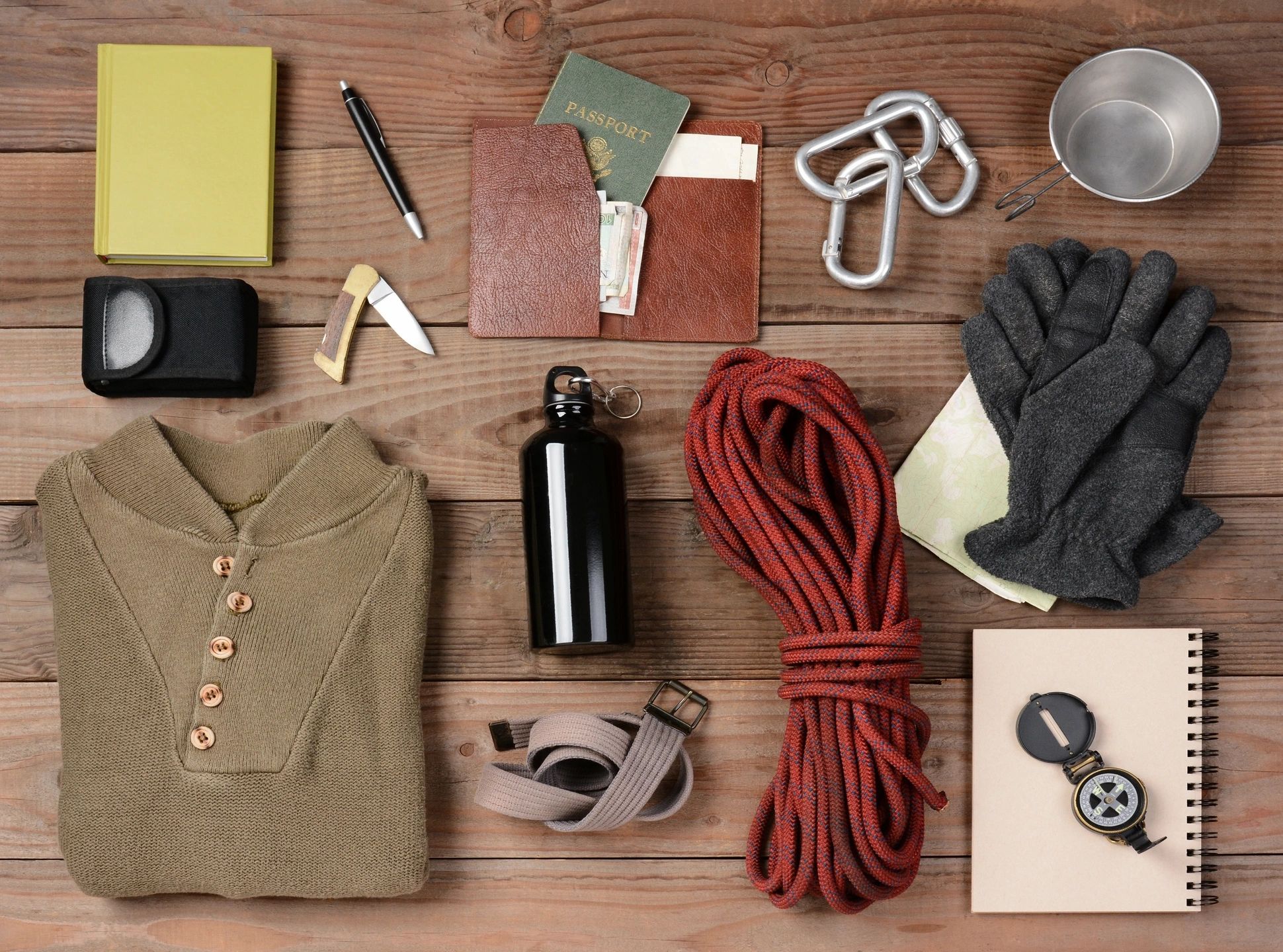
What we carry, what we consider before hitting the trail, and some lessons we’ve learned—sometimes the hard way.
Hiking with our dogs is one of our favorite ways to explore. Give us a beautiful trail, a backpack, our dog beside us and somewhere interesting ahead, and we’re pretty happy.
But we’ve also learned that a good day hike starts before anyone puts a paw—or hiking boot—on the trail.
For us, preparation isn’t about stuffing a backpack with every emergency item ever invented. It’s about understanding where we’re going, what conditions we may encounter, what we and our dog can reasonably handle, and what we’ll need if things don’t go exactly according to plan.
Our philosophy is pretty simple:
Plan. Prepare. Then Play! 🐾🥾
Know the trail. Know the conditions. Know your dog. Know yourself.
Pack what you reasonably need. Have a plan if something goes wrong.
Then go have fun!
One important distinction before we start: This article is about day hiking with your dog—not backpacking with your dog. I’ve backpacked, but I have never backpacked with a dog, and I don’t want to pretend the same checklist automatically applies. Overnight backcountry travel with a dog brings additional considerations that are outside the scope of this article.
Not sure where a nature walk ends and a day hike begins—or how backpacking fits into the picture? We explore the differences in A Walk in Nature, a Day Hike, or Backpacking With Your Dog? 🐾🥾

STEP 1: PLAN 🗺️
Know Before You GoBefore the Hike: A Little Homework Can Prevent a Lot of Trouble
We don’t think a good hiking checklist starts with shopping.
It starts with knowing where you’re going.
Before we head out, we want to know:
- Are dogs actually allowed on this trail, and what are the leash rules?
- How long and difficult is the hike, including elevation gain?
- What terrain, shade and exposure should we expect?
- What’s the weather forecast, and what are the current trail conditions?
- Are there seasonal hazards or wildlife concerns?
- Is cell service reliable, and how far will we be from help?
A three-mile shaded forest hike on a cool morning isn’t the same outing as three exposed miles through the desert. And a familiar trail in summer may be a very different trail after a winter storm.
Know How You’re Getting There—and Back
Phones and hiking apps are incredibly useful. We use them too.
But cellular service can disappear surprisingly quickly once you’re on a trail.
If you’re using a hiking app that offers offline maps, download your route before leaving reliable service. Make sure your phone is charged and understand how to use whatever navigation system you’re relying upon.
Personally, I still like having a paper map when one is available and appropriate.
Technology is wonderful.
Technology with a backup plan is even better.
Tell Someone Where You’re Going
This may be one of the most important pieces of hiking preparation we do—and it doesn’t weigh anything.
Before leaving, tell a reliable person who isn’t hiking with you:
- Where you’re going and which trail or route you intend to take.
- Approximately when you’re starting.
- When you reasonably expect to return.
- When they should become concerned if they haven’t heard from you.
- For a more remote outing, your trailhead, vehicle information and what they should do if you’re overdue.
And remember to tell them when you’re safely back.
A phone doesn’t replace this plan. Cell service disappears. Batteries die. Electronics can be lost or damaged.
Before starting a hike, ask yourself:
If something goes wrong here, how will I call or signal for help?
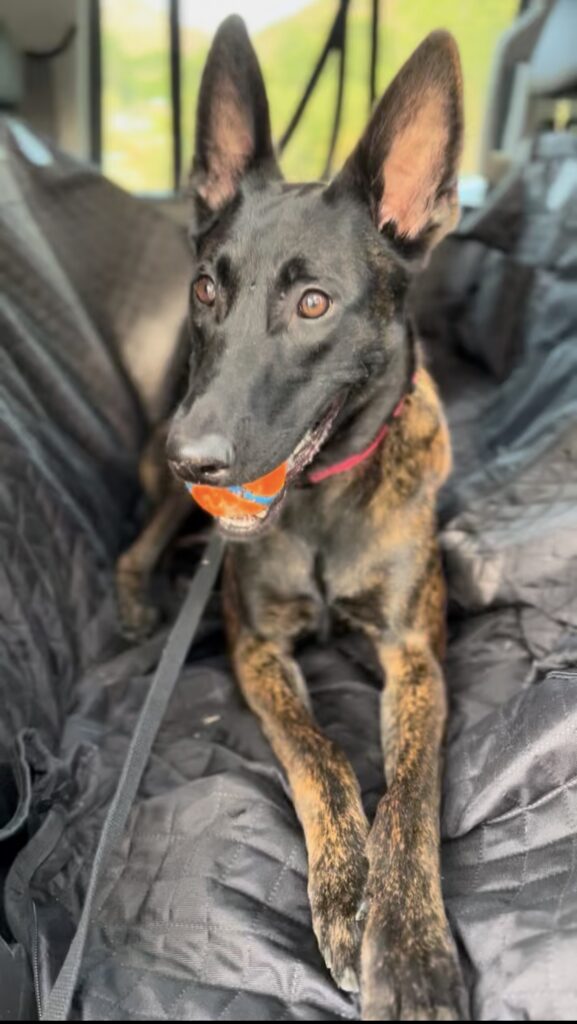
You’re Part of Your Dog’s Safety Plan, Too
We spend a lot of time thinking about keeping our dogs safe.
But there’s another half of that equation.
We need to keep ourselves safe, too. Our dogs are depending on us to get them home.
If you become injured, lost, dehydrated, overheated or unable to continue, your dog is now part of that emergency too.
That’s why proper hiking footwear, water, food, sun protection, appropriate clothing, navigation and human first aid belong in an article about hiking safely with a dog.
Before heading out, consider two questions:
If my dog couldn’t walk, how would I get them back to the trailhead?
If I couldn’t walk, what would happen to my dog?
Getting a 15-pound dog off a trail is very different from evacuating a 75-pound dog.
We may not have a perfect answer for every possible situation. But we’d rather think about it at home than encounter the question for the first time several miles down a trail.
Because the middle of an emergency is a terrible time to start making the plan.
What Is Your Water Plan?
“It’s Only a Short Hike” Is Not a Water Plan
Water deserves more than a single line on a packing list.
Sometimes people don’t forget water.
They decide they won’t need it.
It’s only a short hike.
It’s cool today.
We won’t be gone long.
We’ve made that mistake ourselves.
Years ago, my husband and I were hiking near Devils Postpile. We hadn’t planned to continue all the way to Rainbow Falls, but it was a beautiful day. We knew the area well. Eventually, the temptation won:
Let’s go.
And we ran out of water.
Thankfully, it never became a medical emergency, but things went downhill enough that we learned a lesson we’ve never forgotten.
And here’s the part that still gets me: we weren’t inexperienced hikers.
I had known that area since childhood and had backpacked in the John Muir Wilderness.
Experience didn’t protect us from a bad decision.
We knew better. We simply let a beautiful day, familiarity with the area and the temptation to keep going override what we already knew.
That’s why we carry water even when a hike seems short or the weather feels comfortable.
Plans change. Wrong turns happen. Trails take longer than expected. Temperatures rise. A water source you expected to find may be unavailable—or may not be safe to drink.
Don’t make your safety plan dependent on something being available later.
Bring Clean Drinking Water for Your Dog
We carry clean drinking water for our dog rather than assuming we’ll find something safe along the trail.
There isn’t one perfect amount for every dog or every hike. Needs can change with the dog’s size and individual needs, exertion, temperature, humidity, elevation, sun exposure and the difficulty and duration of the hike.
So we plan for our dog, this hike and today’s conditions, with some margin for the unexpected.
And we don’t wait for our dog to look desperate for water before offering it.
Water is heavy. That’s one reason we’re thoughtful about the weight of everything else in our backpacks.
But this is one place where we’d much rather carry a little extra than discover halfway down the trail that we didn’t bring enough.
Clear Water Doesn’t Necessarily Mean Safe Water

We’ve heard this more times than we can count:
“It’s running water. It looks clean. It’s fine.”
Unfortunately, clear isn’t the same thing as safe.
Natural water can contain organisms we can’t see. Leptospira bacteria, Giardia and Cryptosporidium are among the potential hazards associated with contaminated water. A beautiful mountain stream can look perfectly clear and still contain something capable of making you and your dog sick.
That’s one reason we don’t consider a stream, lake, or puddle our dog’s drinking-water supply simply because it looks pristine.
We bring clean drinking water for our dog. It weighs more. It’s worth carrying.
Want to learn more?
- CDC: Leptospirosis in Animals
- CDC: About Giardia and Pets
- Veterinary information: Cryptosporidiosis in Dogs — VCA Animal Hospitals
If your dog hikes, spends significant time outdoors, or may encounter natural water sources, talk with your veterinarian about leptospirosis, your dog’s individual risk and whether that vaccination is appropriate.
Know When to Turn Around
Sometimes the safest hiking decision is also the most disappointing one.
Turn around.
Maybe your dog is struggling.
Maybe you’re struggling.
Maybe the weather changed, the trail is more difficult than expected, daylight is disappearing, you’ve used more water than planned or something simply doesn’t feel right.
You don’t have to finish a trail just because you started it.
Turning around is always an option.
The trail will still be there.
And that includes the photograph you drove three hours to get.
Beautiful overlooks, remote landmarks and dramatic landscapes can make us want to go just a little farther—especially after we’ve traveled a long way to get there.
But no photograph is worth ignoring heat, weather, closures, barriers, wildlife, deteriorating trail conditions or your own or your dog’s limits.
No photo is worth putting you or your dog in danger.
Sometimes the smartest adventure is the one you decide not to finish.
Before We Start Walking: Our Mental Checklist
☐ Do we know our route and the dog rules?
☐ Have we checked today’s weather and trail conditions?
☐ Do we have enough clean water for the humans and dog, with a reasonable margin?
☐ Does someone who isn’t hiking know where we’re going and when to become concerned?
☐ Will our navigation work if we lose cell service?
☐ If something goes wrong, how will we call or signal for help?
☐ If our dog can’t walk, how will we get them out?
☐ If one of us can’t walk, what happens to our dog?
☐ Are we willing to turn around?
If the answer to that last one is no, we probably shouldn’t start the hike.
Affiliate Disclosure: Some links in this article are affiliate links, including Amazon and K9 Ops USA. If you purchase through them, we may earn a small commission at no additional cost to you. We recommend products based on our own experience and preferences.
As an Amazon Associate I earn from qualifying purchases.
STEP 2: Prepare 🎒
Pack for the Hike You’ve Planned
Pack for the hike you’re actually taking—not every emergency that has ever happened outdoors.
But leave yourself a reasonable margin for things not going according to plan.
What We Actually Carry on a Regular Day Hike
Okay. Now we can finally open the backpack. 🎒
This isn’t intended to be a universal list that every hiker must duplicate exactly. Established hiking-safety guidance, including the Ten Essentials, is an important starting point, and equipment should always be adapted to that particular outing.
This is the basic foundation we actually carry, adjusted as needed for the hike.
There’s also one important difference when my husband and I hike together:
We don’t put every emergency item in one person’s backpack.
Hiking partners can become separated. One person may be injured. Someone may need to go for help. One backpack may become inaccessible.
We don’t duplicate everything, but some small, lightweight essentials are worth carrying individually.
🎒 Each of Us Carries
1. 🗺️🧭 Navigation
This can include one or more of these items: maps both paper and electronic, a compass, GPS, satellite communication tool, phone and backup charging capability — both charged before we leave, but never confused with a guarantee of cell service.
2. Water—and Extra Water 💧
Each of us carries water so we’re not relying on one person’s backpack for our entire supply.
We prefer hydration packs because they keep our hands free while hiking with our dog. We use 2.5- to 3-liter hydration bladders, planning enough clean water for ourselves and our dog, with extra for unexpected delays.
We also look for a side pocket that keeps our dog’s water bottle within easy reach. See details below.
We’ve used our previous hydration packs for over six years, but they’re no longer available. We’re currently trying out replacements and will share a recommendation when we find one we genuinely like!
And for the Dog… 🐾
More About Clean Water and a Practical Drinking System
We plan for our dog’s drinking water from the beginning, carrying the main supply along with ours in the hydration bladder of our pack.
That matters when we’ve carried every ounce of water onto the trail ourselves!
We like our Kurgo dog water bottle because its built-in drinking cup makes it easy to offer our dog water along the trail. And here’s a feature we really appreciate: any water she doesn’t drink can be poured right back into the bottle instead of going to waste!
Kurgo Dog Water Bottle
👉 Blue Kurgo Bottle on Amazon — Currently out of stock, but worth checking for availability.
👉 Red Kurgo Bottle on Amazon — Same bottle, different color. Compare prices before purchasing!
3 & 4. Sun Protection and Extra Clothing ☀️🧥
Sun protection can include sunscreen and clothing that helps shield us from the sun. We combine these two essentials because appropriate outdoor clothing can serve several purposes.
A long-sleeve shirt or lightweight windbreaker can provide protection from sun, wind, and changing temperatures—especially when we’re sweaty, shaded, or delayed longer than expected.
And don’t forget the dog! We’re talking about functional outdoor clothing designed for weather protection, not fashion. On snowy hikes, our dog may wear an insulating sweater beneath an outer coat. Other conditions may call for different protective gear, depending on the weather and our dog’s individual needs.
For dogs, sun protection may also be necessary, depending on their coat, skin, and exposure. If using sunscreen, choose a dog-appropriate product with guidance from your veterinarian rather than applying human sunscreen. Human sunscreen can contain ingredients that are harmful to dogs.
5. Food/Extra Food 🥨🥜🍖
For both humans and dogs.
We pack snacks and extra food appropriate for the hike—for ourselves and our dog. Unexpected delays can make those extra supplies especially welcome. Pack whatever you feel you need for the hike for you and your dog.
6 & 7. 🔪 Knife, Tools, and Fire Making 🔥
— We specifically chose the Leatherman Signal because it combines several useful hiking tools—including a knife, saw, awl, sharpener, fire starter and whistle—in one compact tool. Some features can be operated with one hand, although we always stop to use cutting tools safely.
It’s a little pricey, but we appreciate its versatility. And ours is bright blue! We love the color, and it’s easier to spot if we drop it. 💙
👉 Our Leatherman Signal on Amazon
8. 🔦 Light
Headlamp
— We prefer headlamps to handheld flashlights whenever practical. Managing a leash, helping a dog or using first-aid supplies is much easier when both hands are available.
We use the SUNREI Dual Power headlamp. We particularly like the adjustable light angle, red-light option, rechargeable power and ability to use backup replaceable batteries. The hands-free operation and motion-control feature are practical when we’re juggling equipment or managing our dog.
👉 Our SUNREI headlamp on Amazon
And for the Dog… 🐾
👉 Ruffwear Beacon Safety Light for Dogs. on Amazon
We’ve had our rechargeable Ruffwear Beacon for at least five years, and it’s still going strong! We love that it’s waterproof and holds up to wet, snowy conditions. We use it in low light, after dark, and during inclement weather.
It has three LED color options, which is especially handy with multiple dogs. Each dog can wear a different color, making it easier to tell who’s who and where they are! 🐾
9. 🏕️ Emergency Shelter
Lightweight Emergency Blanket, Bivy, and Weather Protection
For most of our day hikes, we carry a lightweight Mylar emergency blanket. But when hiking in winter, facing unpredictable weather, or heading somewhere more remote, we adjust our supplies.
Depending on the conditions, we may add an emergency bivy, waterproof backpack rain cover, rain poncho, or other protective equipment appropriate for the hike.
Our goal is to be prepared for unexpected delays or emergencies without carrying more than we reasonably need.
10. 🧰➕ First Aid and Safety
Safety
- Signal Mirror — Each of us carries a small signaling mirror designed to attract attention using reflected sunlight. Ours even have instructions printed on the back! 👉 Our signaling mirror on Amazon
- Whistle — Although our Leatherman Signal includes a whistle, we each carry a separate emergency whistle. It’s inexpensive, lightweight, easy to use, and doesn’t need batteries. 👉 Our Emergency Whistle on Amazon
A whistle, signal mirror and the headlamp above give us audible, daytime visual and nighttime signaling options without requiring much additional space.
Our Smaller Hiking First-Aid Kit
We keep a more complete dog first-aid kit with our travel supplies, but we don’t necessarily carry every item on every trail.
For hiking, we’ve assembled a smaller kit with selected supplies for both humans and our dog. We adjust it to the outing, while keeping our more complete supplies at our vehicle or home base.
This is what we’ve chosen to carry, not a universal medical checklist or a substitute for veterinary care and first-aid training. The right contents also depend on the dog’s needs, the hike, and what the person carrying the kit knows how to use.
Our Trail First-Aid Checklist
☐ Personal medications — As needed for each hiker, including the dog if they have something that could be needed on the hike.
☐ Identification and emergency information — In case we’re unable to communicate. For human & Dog
Supplies for Both humans and dogs, as appropriate
☐ Assorted gauze
☐ Non-adherent wound pads
☐ Self-adhering veterinary wrap
☐ First-aid tape
☐ Nitrile gloves
☐ One versatile pair of tweezers
☐ Folding trauma shears
☐ Good-quality handheld hand lens
☐ Safety pin
Human first-aid supplies
☐ BleedStop
☐ Antiseptic wipes
☐ Alcohol swab
☐ Adhesive bandages
☐ Moleskin
☐ Small Neosporin
☐ Fomin Tea Tree Travel Soap sheets for handwashing
Dog first-aid supplies
☐ BleedClot Pet
☐ Vetericyn Plus Wound Care, 3-ounce bottle
☐ Lightweight muzzle, selected and used with veterinary guidance- The muzzle is an emergency-handling precaution, not something to place on a dog experiencing breathing difficulties, vomiting, or heat distress.
Other small emergency essentials
☐ Lightweight emergency Mylar blanket
☐ Small permanent marker
Optional additions if space and conditions warrant
☐ Small hand sanitizer
☐ Cotton-swab applicators
☐ Butterfly bandages or wound-closure strips
☐ Small notepad and pen
We don’t prescribe quantities for most supplies. Space, the length and remoteness of the hike, and individual needs all influence how someone builds a kit.
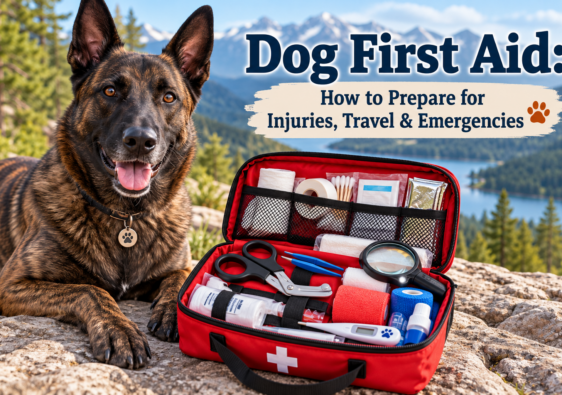
For our larger, more complete first-aid preparation, see our Dog First Aid: How to Prepare for Injuries, Travel & Emergencies.
🩹 A Few First-Aid Tools That Earn Their Space
🔎 Our Handheld Magnifier
Our compact handheld magnifier helps us inspect our dog’s paws, pads, and wounds for cuts, embedded objects, or other visible injuries. It can’t determine how serious an injury is, but it helps us spot details we might otherwise miss. We carry this smaller magnifier rather than our larger lighted one.
We keep this small one attached to the outside of our hiking first-aid bag for easy access.
✂️ Leatherman Raptor Rescue Trauma Shears
These are expensive, and we know it! We use less-expensive trauma shears in our other first-aid kits, but for hiking, we chose the Leatherman Raptor Rescue because we trust its construction and appreciate its compact, folding design.
When we’re miles from help, we want equipment we can depend on.
👉 Our Raptor Rescue shears on Amazon
🩸 Bleeding-Control Supplies
We carry BleedStop for humans and BleedClot Pet for our dog. We chose BleedClot Pet partly because its compact packaging takes up less space than the styptic powder we previously considered.
👉 BleedStop for Humans on Amazon
These products are not interchangeable. Each is intended for its labeled use. Follow product directions and seek appropriate medical or veterinary care for serious wounds, particularly uncontrolled bleeding, deep wounds, or punctures.
🐾 Vetericyn Plus Wound Care
We carry the smaller 3-ounce bottle of Vetericyn Plus Wound Care, a product we already use in our larger dog first-aid kit.
It’s a trail-friendly size of something we’re familiar with, rather than buying a different product just because we’re hiking.
👉 Vetericyn Plus Wound Care on Amazon
🧼 Handwashing Supplies
We carry compact FOMIN Tea Tree Travel Soap Sheets for washing our hands before providing first aid. They’re lightweight, take up very little space, and dissolve in water.
Tea tree oil has been studied for its antibacterial and antifungal properties, although that doesn’t mean these soap sheets are proven to provide those benefits.
Hand sanitizer can be useful, but when our hands are visibly dirty, we prefer soap and clean water.
The soap is for our hands, not our dog’s wounds.
👉 FOMIN Tea Tree Paper Soap Sheets — 3 Pack on Amazon
🥾 Dog Footwear
We carry 👉 Kurgo dog shoes and Kurgo socks (Not an Amazon link) when appropriate for the terrain and conditions. Even if our dog isn’t wearing them at the trailhead, they may be useful if conditions change or a paw becomes irritated.
We also use 👉 Musher’s Secret before or after hikes, rather than routinely carrying the container. Think of feet/paws as the tires of a car. It is so important to take care of your dog’s paws/feet.
🦮 Our Long Line: Why the Details Matter
We use a customized 10-foot K9 Ops long line, carried on our backpack. For hiking, we prefer a manageable 10- to 15-foot range rather than longer training lines that can tangle around rocks, trees, and brush.
We chose a handle for a secure grip and the mid-level Tango clip over the Frog-style clip because we were concerned about accidental opening if the hardware contacted rocks.
The extra length has occasionally helped us guide our dog over small trail obstacles within her ability. This is not rescue or lowering equipment and should never be used to lower a dog over significant drops.
Always follow trail leash-length regulations. Longer leashes aren’t permitted everywhere.
👉 K9 Ops customized leash — product link
Our regular 6-foot leash matters to us as well and after trying out all sorts of leashes, we only use K9-Ops USA leashes. We usually get a Ready To Ship 6 foot leash that has a 3/4 inch width, but if they are all out, you can order a custom 6-foot leash 👉 K9-Ops USA 6 foot leash, 3/4 width
💩 Poop Bags—and a Plan for the Full Ones
Bringing poop bags is only half the job. Filled bags need to leave the trail with you!
Dog waste can introduce pathogens and excess nutrients into the environment, potentially affecting water quality. And we’ve seen far too many filled poop bags abandoned along trails or tied to trees. Please don’t do this! Someone else shouldn’t have to clean up after our dogs.
👉 Give a Shit Dog Poop Bags with Handles on Amazon
The National Park Service’s B.A.R.K. Ranger principles begin with Bag your pet’s waste, but that responsibility belongs everywhere we hike.
We always bring a sanitary way to carry filled bags until we reach a proper trash receptacle.
Leave only footprints. Take only memories. And take your poop bags with you! 🐾💩
Some Important Gear Never Goes in the Backpack
Proper Hiking Footwear
Wear shoes or boots appropriate for the terrain and conditions.
This isn’t merely about avoiding sore feet.
A slip, fall, ankle injury or loss of traction can turn into an emergency for both you and the dog depending on you.
Secure Dog Equipment and Current Identification
Use a secure leash and appropriate harness or collar, follow the rules of the trail and make sure your dog’s identification information is current before you leave home.
Think about whether your equipment is suitable for the trail you’re actually hiking—not merely whether it’s comfortable for a neighborhood walk.
Pack for the Hike You’re Actually Taking
Our basic pack gives us a foundation.
The particular hike tells us what else belongs in it.
Temperature, weather, elevation, terrain, snow, distance, remoteness, expected cell coverage, daylight, wildlife and the individual needs of both dog and humans can all change what we carry.
Depending on the outing, we may add:
- Gloves, hand warmers and additional warm or waterproof human layers.
- A warm dog coat or appropriate cooling gear.
- Additional water and food.
- Trekking poles or a collapsible hiking stick.
- Snow or traction equipment.
- Additional emergency shelter.
- Expanded first-aid and repair supplies.
We don’t normally use trekking poles on every hike because we’re often managing our dog, but we’ll sometimes attach a compact pole or hiking stick to the outside of the pack. In snow, poles become much more important to us, particularly when we’re dealing with snowdrifts or uncertain footing.
When We Add More Emergency Equipment
For longer, more remote, later-in-the-day or otherwise higher-consequence hikes—where an unexpected delay could leave us out much longer than planned—we may expand our supplies.
For example, we may add:
- A rolled aluminum splint, such as the Ever Ready First Aid 24-inch splint we use.
- Zip ties and a small amount of duct tape for appropriate equipment repairs.
- Additional emergency shelter, clothing and supplies suited to the conditions.
- Other equipment based on the specific hazards and distance from help.
Our Leatherman Signal already includes a ferrocerium fire starter, so we don’t describe that capability as something we only add on longer hikes. For a hike where emergency fire preparation matters, we consider the complete situation and whether we have the supplies and knowledge to use them safely and legally.
Depending on remoteness, terrain and expected cellular coverage, an emergency satellite communicator or Personal Locator Beacon may also be worth considering.
And we think about dog evacuation equipment too. A dog carry-out sling may be useful for some dogs and situations, but fit, weight, terrain and the handler’s ability to use it matter. We don’t currently have a particular sling we’re prepared to recommend.
Preparation isn’t carrying everything. It’s understanding when you need more.
Plan, Prepare, Then Play 🐾
Planning and preparation aren’t supposed to take the adventure out of hiking.
For us, they’re what make the adventure possible.
We don’t hike afraid of everything that might happen. We don’t carry every emergency item ever invented. And having hiking experience certainly doesn’t mean we never make mistakes.
We’ve learned some of our best lessons by making them.
Experience doesn’t make us immune to mistakes. Planning and preparation give us more ways to recover from them.
So know the trail.
Bring clean water.
Wear the right shoes.
Pack for the conditions.
Take care of your dog.
Take care of yourself.
Tell someone where you’re going.
And be willing to turn around.
STEP 3: PLAY 🐾 Go Have the Adventure!
Because hiking with your dog isn’t supposed to be scary.
It’s supposed to be fun.
We just want everyone—two-legged and four-legged—to come home safely afterward. 🐾🥾❤️