First aid supplies, emergency contacts, poison control, pet-sitter preparation and trusted resources to help you prepare before your dog needs help.
Accidents have an annoying habit of happening when you’re not conveniently standing next to the dog first-aid supplies.
A torn toenail during playtime. A cut paw while you’re traveling. Something suspicious your dog may have eaten. An injury on a hike. Or an emergency that requires you to leave home much faster than you ever imagined.
That’s why we don’t think dog first aid is simply about owning a bag full of medical supplies.
For us, it’s about being prepared before something happens.
We actually keep several dog first-aid kits: a main kit that travels with us on day trips and overnight trips, a smaller kit for hiking, one at home and another basic kit with our emergency-preparedness supplies.
Does everyone need that many?
Absolutely not. 😂
But we do think every dog owner should consider what makes sense for their dog, their activities and their life.
Before we look inside the kit, though, there’s one thing more important than anything we’re going to put in it.
🩺 Our First Aid Rule: The Kit Never Replaces the Vet
We never use our dog first-aid kit as a substitute for veterinary care.
For us, its purpose is to give us supplies we may need to respond to an injury or emergency, help stabilize what’s happening when appropriate, and get our dog to veterinary care.
Sometimes that may mean dealing with something relatively minor. Other times, first aid is simply what happens between:
“Something is wrong.”
and
“We’re on our way to the vet.”
Merck Veterinary Manual makes the same important distinction: a first-aid kit is not a substitute for veterinary care, and pets should be evaluated by a veterinarian as soon as possible in an emergency.
We also think knowing how to use what’s in your kit matters just as much as owning it.
Talk with your veterinarian when you’re building your dog’s kit. Ask whether your particular dog needs additional supplies or medications and, just as importantly, learn how and when to use them before an emergency happens.
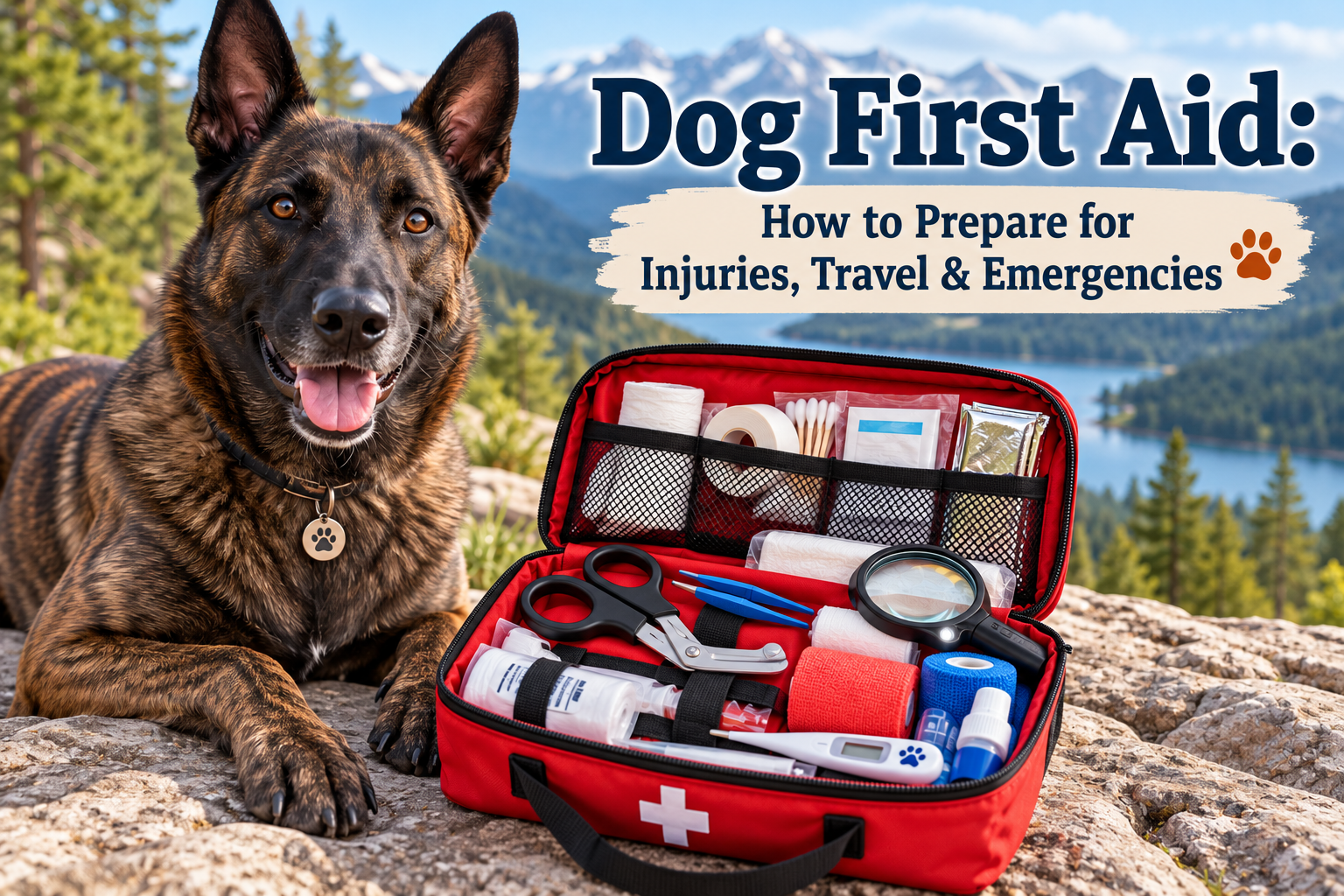
🧰 What Should Be in a Dog First Aid Kit?
Think of this as a starting point, not a one-size-fits-all medical kit.
Your veterinarian may recommend different or additional supplies based on your dog’s health, medications, activities and individual needs. Veterinary first-aid guidance from Merck and AAHA includes many of the wound-care, bandaging, monitoring and handling supplies below.
🩹 Wound Care, Bleeding & Bandaging
☐ Sterile gauze pads
☐ Gauze rolls
☐ Self-adhering veterinary wrap/stretch bandage
☐ Medical/adhesive tape
☐ Clean towels or cloths
☐ Pet-appropriate wound-care supplies recommended by your veterinarian
We’ve needed wound-care supplies more times than we would like.
Torn toenails. A torn ear. Cuts. And occasionally one of those moments after the dogs have been roughhousing when they seem perfectly happy and we’re the ones suddenly wondering why somebody is bleeding.
When needed, we use direct pressure to help control bleeding while we’re assessing what happened and determining what veterinary care is needed. Merck identifies firm direct pressure as an important response to bleeding.
Affiliate Disclosure: As an Amazon Associate I earn from qualifying purchases. Some links in this post are affiliate links, which means we may earn a small commission if you make a purchase through them, at no additional cost to you. We only recommend products we actually use or have carefully researched and chosen for our own dogs.
🐾 What We Actually Use for Wound Care
Vetericyn Plus Antimicrobial Wound Care + Hydrogel — These aren’t products that just sit untouched in our first-aid kit. We’ve used them many times with our dogs, both at home and while traveling.
We use the wound-care spray to clean the area and the hydrogel when we want a protective layer afterward. We particularly like that they’re made specifically for animals, and the manufacturer states they’re safe if licked.
They’ve worked well enough for us over the years that they’ve earned a permanent place in our first-aid supplies.
👉 Check Out Vetericyn Plus Antimicrobial Wound Care on Amazon
👉 Check Out Vetericyn Plus Hydrogel on Amazon
🩸 Why We Carry Two Types of Bleeding-Control Products
Not all bleeding is the same, so we don’t expect one product to do every job.
Kwik Stop Styptic Powder + Styptic Gel Swabs — We keep these for smaller bleeding problems such as a torn or bleeding nail. We’ve actually used Kwik Stop with our dogs and like having both the powder and individually packaged swabs available.
👉 Check Out Kwik Stop Styptic Powder on Amazon
👉 Check Out Kwik Stop Styptic Gel Swabs on Amazon
BleedClot Pet — We also carry a product intended for more serious bleeding. We already use and trust this manufacturer’s human bleeding-control product in our own first-aid supplies, which is what led us to research its animal-specific version.
BleedClot Pet is specifically marketed for veterinary use, including severe bleeding wounds, and the manufacturer provides animal-model clinical and safety evidence for the product.
👉 Check Out BleedClot Pet on Amazon
We want to be clear about the distinction: we have used the manufacturer’s human product ourselves, but we have not personally had to use BleedClot Pet on one of our dogs.
And we hope we never do.
Severe or uncontrolled bleeding is an emergency. We wouldn’t use a bleeding-control product as a reason to delay veterinary care. Direct pressure and getting our dog to emergency veterinary care remain the priority; this is another tool we want available while we’re responding to the emergency. Merck likewise advises firm pressure for bleeding and veterinary attention for emergencies.
A Quick Note About Self-Adhering Wrap
We like self-adhering veterinary wrap because it sticks to itself rather than the dog’s fur, making it useful for securing a dressing.
But this is also a perfect example of why having the equipment isn’t the same as knowing how to use it.
Bandages need to be applied properly.
👉 See the Self-Adhering Veterinary Wrap We Keep in Our Kit on Amazon
Ask your veterinarian or learn through a reputable pet first-aid course how to properly use the bandaging supplies you keep in your kit.
💧 Cleaning & Flushing
☐ Saline solution
☐ Syringe or eyedropper
☐ Sterile eye wash appropriate for dogs
AAHA includes saline and a syringe or eyedropper among its recommended first-aid supplies.
👁️ Eyes Are One Place We Don’t Improvise
We keep a sterile eye wash appropriate for animals in our first-aid kit.
Don’t substitute medicated human eye drops or multipurpose contact-lens solutions for a dog eye wash. Human eye products can contain medications, preservatives or other ingredients that aren’t appropriate for your dog’s eyes. Plain sterile saline without additives can be used for flushing, but when it comes to anything else going into our dogs’ eyes, we want veterinary guidance rather than guessing.
Vetericyn Plus Antimicrobial All Animal Eye Wash is the one we keep in our kit.
👉 Check Out Vetericyn Plus Antimicrobial All Animal Eye Wash on Amazon
Ask your veterinarian what they recommend keeping for your dog and how they want you to use it. And remember: rinsing an eye doesn’t mean an injured, painful or abnormal-looking eye no longer needs veterinary care.
✂️ Tools
☐ Blunt-ended bandage scissors or trauma shears
☐ Tweezers or forceps
☐ Dog thermometer
☐ Lubricating jelly, if required for the thermometer your veterinarian recommends
☐ Small flashlight
☐ Disposable gloves
☐ Lighted magnifying glass — our personal addition
Merck includes blunt-ended scissors, tweezers or forceps, a rectal thermometer, lubricating jelly and disposable gloves in its basic pet first-aid kit. AAHA also recommends a thermometer, preferably bandage scissors, tweezers, gloves and a small flashlight.
✂️ Why We Carry Trauma Shears
I worked as an EMT for years, so when we assembled our dog first-aid kits, trauma shears were an obvious choice for us.
They’re strong, designed for emergency situations and have a blunt tip, which matters when you’re cutting material near an injured dog.
And yes…
Ours really can cut through a penny. 😂
Hopefully that’s one capability we’ll never need during a dog emergency.
👉 See the Trauma Shears We Keep in Our Kit
🔍 One of Our Most-Used Extras: A Lighted Magnifying Glass
This isn’t something we’re suggesting every dog first-aid kit on Earth must contain.
But ours has earned its spot.
We’ve used a lighted magnifying glass more times than we can count—at home, on day trips and while traveling—to get a better look at something small.
Is that bump a tick?
Is there a little cut hiding under all that fur?
What exactly are we looking at?
Being able to see the problem clearly can be surprisingly useful.
👉 See the Lighted Magnifying Glass We Use on Amazon
Tweezers
Tweezers are already a standard first-aid-kit tool, but after trying different ones, we have a pair we like enough to keep in ours.
They’re useful for those small jobs where fingers simply aren’t precise enough.
👉 See the Tweezers We Keep in Our First Aid Kit on Amazon
🌡️ About the Thermometer
This is one item we’re not going to recommend through an affiliate link.
A thermometer belongs in the kit, but we’d rather have you ask your veterinarian which type is appropriate for your dog and have them show you how to use it safely.
Merck’s current basic first-aid list specifies a rectal thermometer and lubricating jelly.
Rather than buying one and trying to figure it out during an emergency, this is a perfect question for your veterinarian while everybody is healthy and calm.
🔦 Why We Like a Flashlight With a Side Light
Rechargeable Flashlight With Side Light — This is the same flashlight we keep in our basic travel gear, but there’s one feature we especially appreciate for a first-aid kit: the side light.
A regular flashlight beam is great when we need to see something specific, but the side light can illuminate a larger area when we need more general light—whether we’re dealing with something in a dark room, beside the car or somewhere outdoors.
In an emergency, we like having both options in one flashlight rather than relying only on a narrow beam.
👉 Check Out the Rechargeable Flashlight We Use on Amazon
🐕 Safety, Handling & Transport
☐ Properly fitting muzzle, if appropriate for your dog
☐ Blanket and/or towel
☐ Instant cold pack
☐ A plan for safely moving or transporting your dog if they can’t walk
Why a Muzzle Is in Our Kit
We originally didn’t think we needed one.
Our dogs weren’t dogs we considered likely to bite.
Then one of our dogs was injured. She was at a veterinary office she actually liked, but she was scared and hurting—and she tried to bite the veterinarian.
That changed our thinking.
Pain and fear can change a dog’s behavior.
But here’s something we didn’t know before researching this article:
A muzzle isn’t appropriate for every dog or every emergency.
Merck specifically cautions against muzzling short-nosed breeds such as pugs and bulldogs, as well as dogs with chest injuries, and says a muzzled dog should never be left unattended.
We didn’t know all of that—which is exactly why we think this is something to discuss with your veterinarian before an emergency happens.
Ask whether a muzzle is appropriate for your dog, what type and fit they recommend, how to use it safely and when not to use one.
💊 What About Medications?
This is one area where we’re deliberately not giving medication or dosage recommendations.
We carry an antihistamine in our own kit—but the medication and dosage instructions we follow came from our veterinarian for each individual dog.
What we do for our dogs does not automatically apply to yours.
AAHA recommends discussing both the appropriate antihistamine and the proper dosage with your veterinarian and cautions that not all antihistamine products are safe for pets.
So instead of us telling you what to buy or how much to give:
Ask your veterinarian whether your dog should have medications in the first-aid kit, which ones, when they should be used and the appropriate dose for YOUR dog.
If your dog takes prescription medication regularly, ask your veterinarian what you should have available for travel and emergencies.
📋 Emergency Information Is First Aid Equipment, Too
Some of the most important things in our first-aid kits aren’t medical supplies.
They’re information.
Consider keeping:
☐ Your regular veterinarian’s name, phone number and address
☐ Emergency veterinary hospital information
☐ Animal poison-control information
☐ Important medical and vaccination records
☐ Your dog’s current medications and instructions
☐ Important medical conditions/allergies
☐ Information about who may seek veterinary care for your dog if you can’t be reached
☎️ Put Animal Poison Control Where You Can Find It FAST
We don’t keep the animal poison-control number in just one place.
It’s with our emergency information. It’s saved in our phones. And when someone else is caring for our dogs, we make sure they know where to find it too.
We’ve had to call animal poison control ourselves—both when we knew one of our dogs had eaten something potentially dangerous and when we weren’t sure whether they had.
In our experience, calling specialists who deal specifically with pet poisonings has sometimes gotten us the information we needed faster than calling our regular veterinary office, explaining what happened, waiting while the office consulted the veterinarian and then hearing back.
That’s our experience, not a promise that poison control will always be faster than your veterinarian.
And yes, there can be a charge.
When we’ve needed the service, it has been worth the money to us.
ASPCA Animal Poison Control Center
(888) 426-4435
The ASPCA currently states that its Animal Poison Control service is available 24 hours a day, 365 days a year, and that a consultation fee may apply.
ASPCA Animal Poison Control Information
We aren’t going to recommend home poisoning treatments here. If we think one of our dogs may have been poisoned or eaten something potentially dangerous, we want instructions from a veterinarian or animal poison-control professional who can evaluate that dog and that situation.
🏠 Prepare Your Pet Sitter Before There’s an Emergency
A first-aid kit isn’t much help if the person caring for your dog doesn’t know where it is—or doesn’t know what to do if something happens.
When we’re leaving our dogs with our pet and house sitter, we make sure they know where our emergency information and supplies are kept.
We’ve also given our veterinarian our sitter’s name and asked the office to note that this person has our permission to seek veterinary care for our dogs if we’re away and can’t be reached.
We trust our veterinarian and our sitter to recognize when our dogs need emergency care, and we don’t want valuable time lost trying to establish what we’ve authorized.
Veterinary-office policies can vary, so ask your own veterinarian before traveling what they need from you if someone else may need to seek care for your dog while you’re unavailable.
That’s another part of emergency preparedness that’s much easier to arrange before anyone needs it.
🧳 Do You Need More Than One Dog First Aid Kit?
Maybe.
We do.
Our main first-aid kit goes with us on all-day outings and overnight trips.
It’s also much too big to drag around on a hike. 😂
So we have a smaller hiking kit with the supplies we want on the trail.
We also keep a home first-aid kit and another basic kit with our emergency-preparedness supplies.
For us, there’s another reason.
We live in California, where earthquakes are part of our emergency planning.
Wildfires are too.
We’ve had to evacuate our home three times because of wildfires. Twice, the fire burned into our yard but fortunately spared our house.
One thing those experiences taught us is:
When it’s time to evacuate, you may have far less time to leave than you imagine.
We don’t want to be searching for gauze, medications, emergency phone numbers and dog supplies while we’re also trying to evacuate.
We want those things already together.
That doesn’t mean you need four first-aid kits.
Think about your own life.
Do you travel frequently? Hike? Camp? Leave your dog with a sitter? Live somewhere where wildfires, earthquakes, hurricanes, severe weather or other emergencies require advance preparation?
Your setup should fit your life—not ours.
🔄 Maintain the Kit You Worked So Hard to Build
Building the kit isn’t the end of the job.
Things get used. Products expire. Batteries die. Information changes.
And apparently supplies don’t magically replace themselves after we use them.
Rude. 😂
Periodically:
☐ Check expiration dates
☐ Replace anything you’ve used
☐ Check supplies and packaging for damage or deterioration
☐ Check flashlights and other battery-powered equipment
☐ Update veterinary and emergency contact information
☐ Update medical and vaccination records
☐ Review dog-specific medications and instructions with your veterinarian
Merck recommends checking medication expiration dates at least annually and replacing items as needed.
We also like replacing something when we use it, rather than discovering the empty spot the next time something happens.
🩺 Having the Supplies Isn’t the Same as Knowing How to Use Them
You can have the world’s most beautifully organized dog first-aid kit and still not be prepared if you don’t know what to do with what’s inside it.
We’d rather learn something while everybody is safe and calm than try to figure it out for the first time while one of our dogs is frightened, hurting or bleeding.
That’s why we think learning pet first aid and CPR before an emergency is worth considering.
Merck recommends knowing how to use everything in a pet first-aid kit and notes that first-aid and CPR classes may be available through veterinarians, community colleges and organizations such as the Red Cross.
❤️ American Red Cross Cat & Dog First Aid Course
The American Red Cross currently offers a 35-minute online Cat and Dog First Aid course covering subjects including vital signs, breathing and cardiac emergencies, wounds, bleeding, seizures and preventive care.
Learn About the American Red Cross Cat & Dog First Aid Course
The Red Cross also offers a free Pet First Aid app with emergency information and educational resources that can be useful to have available on your phone.
Explore the American Red Cross Pet First Aid Resources
🫀 CPR, Choking & Heatstroke
We don’t want to turn Traveling Dogs Life into a do-it-yourself veterinary emergency manual.
Instead, we’d rather point you toward reputable resources where you can learn emergency skills before you need them.
How to Perform CPR on Dogs — AKC
Dog Choking: What You Need to Know — AKC
And because heatstroke is a potentially life-threatening emergency:
Heatstroke in Dogs: Signs, Symptoms & What to Do — AKC
The AKC notes that CPR should only be used when necessary because performing it on a healthy dog can cause serious harm, and its heatstroke guidance stresses veterinary evaluation even if a dog seems to recover after cooling. Those are good examples of why we’d rather send readers to veterinary-reviewed resources than try to squeeze emergency procedures into this article.
🐾 Read Next: Is It Too Hot for Your Dog? Paw, Pavement & Summer Heat Safety
🐾 Build the Plan for YOUR Dog
There probably isn’t one perfect dog first-aid kit—or one perfect emergency plan—for every dog, household and adventure.
Start with the basics.
Talk with your veterinarian.
Think about your dog’s health, medications and activities. Think about where you travel and what emergencies are realistic where you live. Think about who else cares for your dog and what they would need if you weren’t there.
Then learn how to use what you’ve packed.
Our first-aid supplies have helped us through relatively ordinary dog mishaps, and they’re also part of our preparation for much bigger emergencies we hope never happen.
We hope we never need most of what’s inside our kits.
But we’d much rather have those supplies ready and never need them than need them and wish we’d prepared sooner.
Because the middle of an emergency is a terrible time to start making the plan. 🐾❤️