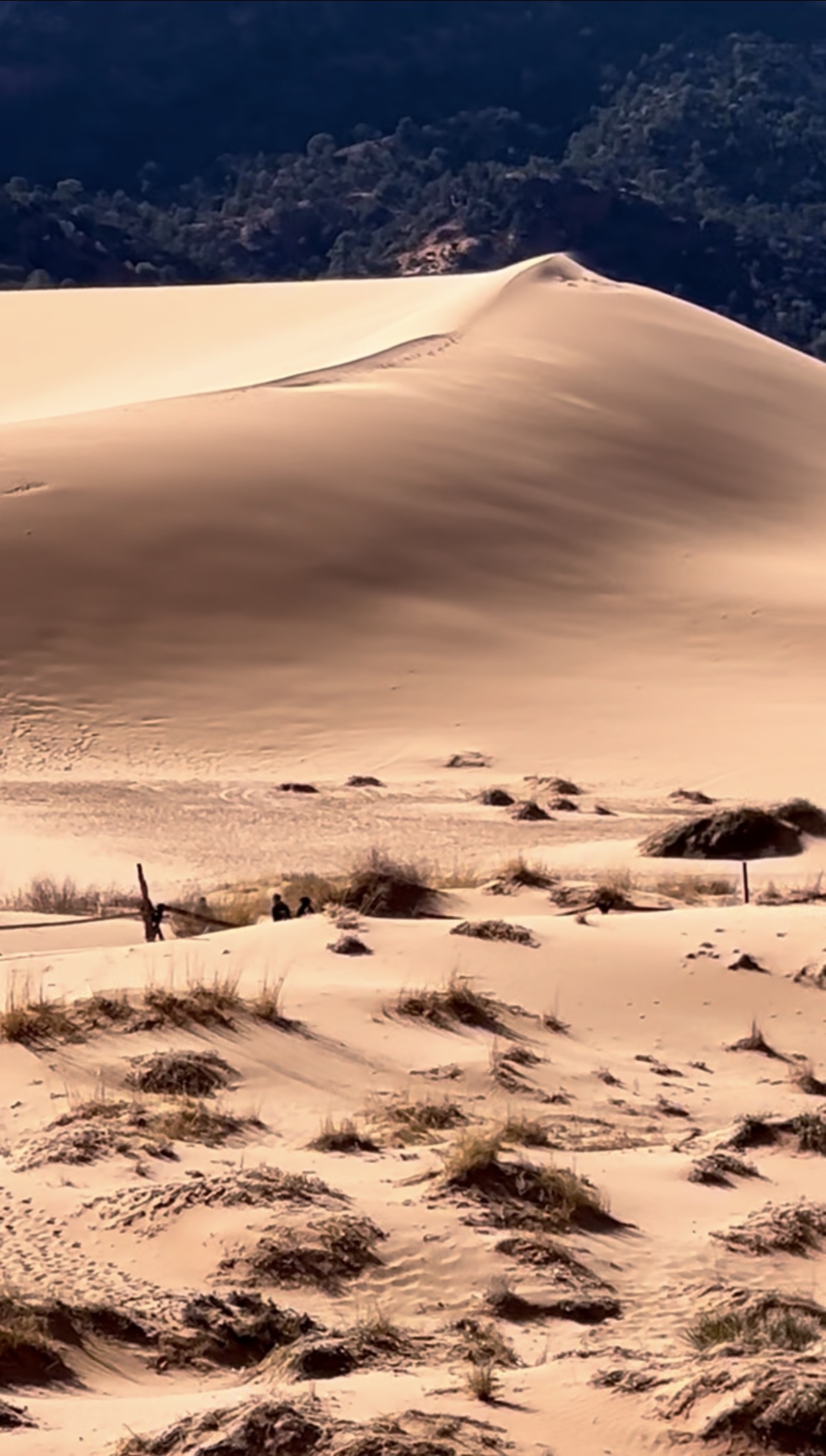
Pink sand, big adventures, sand sledding, wildlife—and everything you need to know before bringing your dog!
🌤️ When to Go: This is a great cool-season adventure from late fall through early spring, when temperatures are much more comfortable for exploring with your pup. We’d skip this one during the hot summer months, late spring, and early fall—the sand heat can be tough on both you and your four-legged adventure buddy even with protective gear! 🐾
Have you ever looked at a picture of a place and thought, “Wait…that’s really in Utah?!” 😂
That’s exactly how we felt about Coral Pink Sand Dunes State Park.
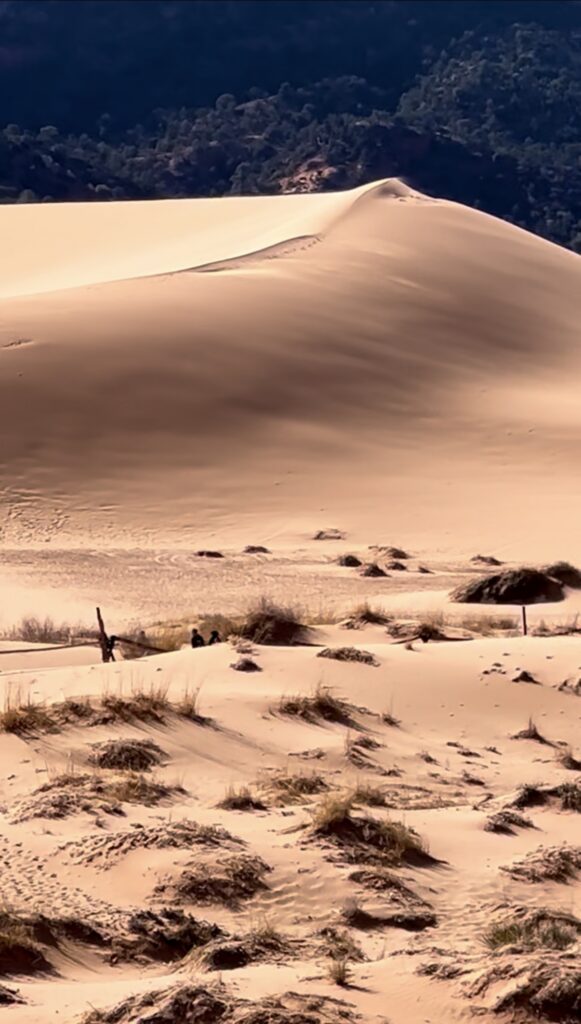
Tucked away in Southern Utah near Kanab, this place looks like someone took a giant paintbrush and swept waves of coral-colored sand across the desert. Add blue skies, red cliffs, juniper and pinyon trees, and a four-legged adventure buddy, and you’ve got one pretty incredible day trip! 🐾
And here’s the really fun part:
Dogs are welcome!
If you’re traveling through Southern Utah with your dog, Coral Pink Sand Dunes deserves a spot on your adventure list.
🐾 Welcome to the Pink Sand!
Coral Pink Sand Dunes isn’t your typical state park.
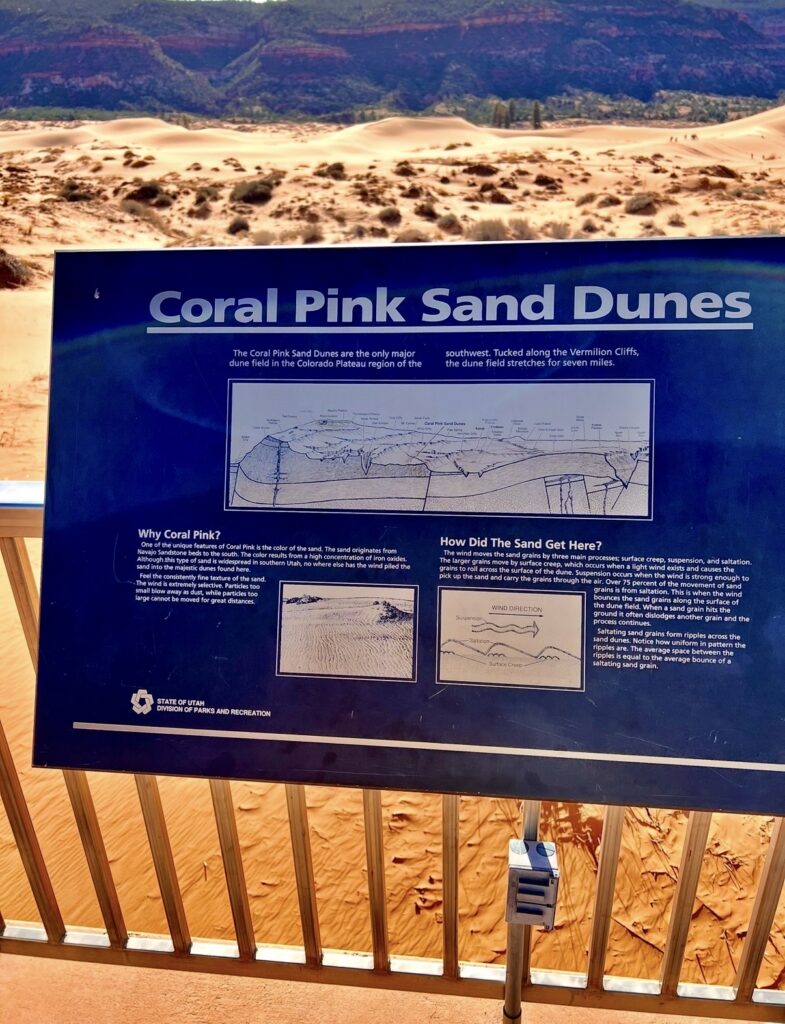
The dunes were created over thousands of years as wind moved sand from the surrounding Navajo sandstone into this unusual basin. The result is a constantly changing landscape of coral and reddish-pink sand. Some of the dunes can shift significantly over time as the wind moves the sand.
And when you see it in person, the color is amazing.
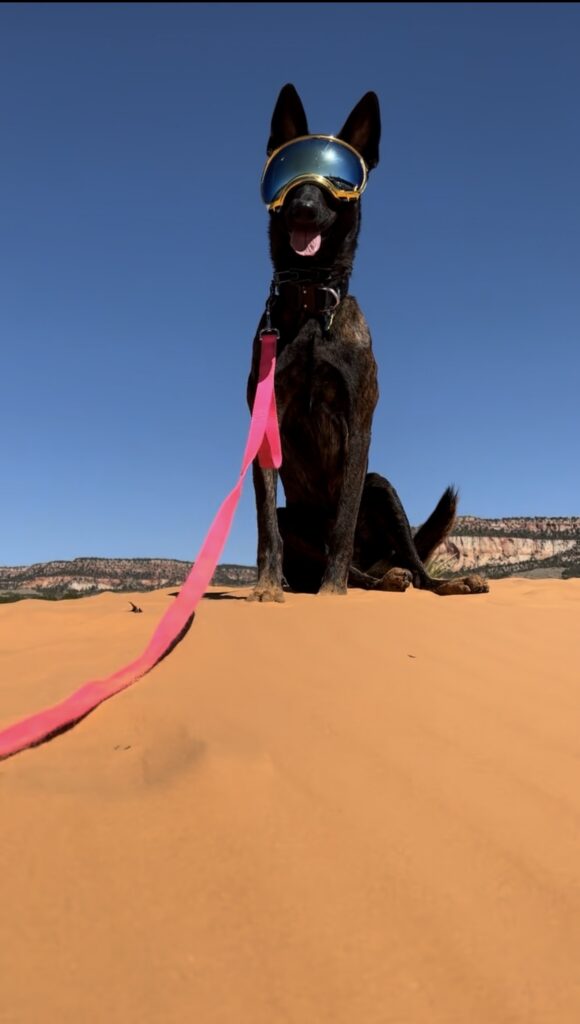
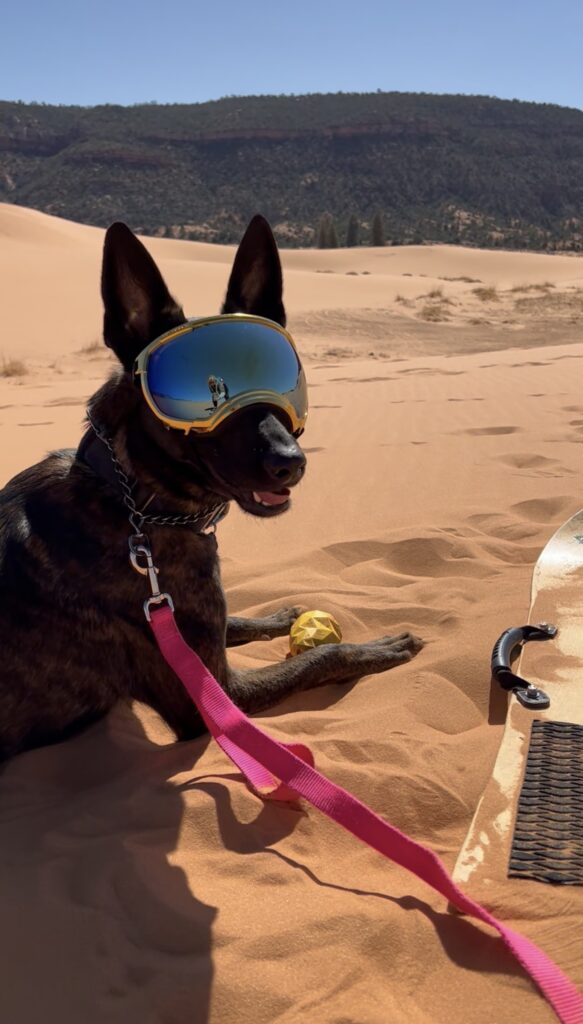
It’s one of those places where you’ll probably take approximately 147 pictures of the same dog standing in the sandbecause every direction looks different. 😂📸🐶
The park is also unusual because it combines quiet, non-motorized recreation with a major OHV area. About 90% of the dunes are open to off-highway vehicle riding, while the dunes are also available for hiking and playing in the sand.
That means there’s something important to remember if you’re bringing your dog:
Keep your pup on a leash and stay aware of your surroundings.
You don’t want your dog taking off after something—or wandering into the path of an OHV.
🌤️ When We Went
We visited during the first week of April, and for us, the weather was absolutely perfect.
It was still chilly enough that we wore light jackets, and our dog needed one too once we got away from the warmer sand.
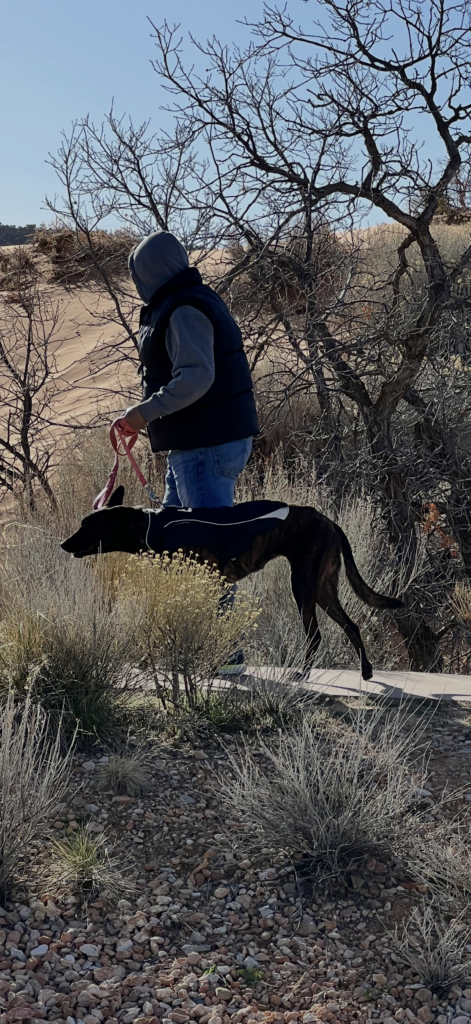
The sand itself was cool to the touch, which was a huge bonus.
We didn’t have to worry about the blazing temperatures, scorching paws, or the intense heat that can make summer desert adventures difficult for dogs.
And the sky?
Blue, beautiful and absolutely perfect for exploring. ☀️
Utah State Parks currently warns that temperatures from May through September can reach the upper 90s and even low 100s, and when the air temperature reaches 100°F, the sand can reach roughly 140°F. From October through April, conditions can vary dramatically—from warm and sunny to snowy and cold.
So our April visit was a great reminder:
Don’t just look at the calendar. Check the actual weather before you go.
For a dog, a beautiful sunny day isn’t necessarily a safe day if the sand is dangerously hot.
Weather → sand temperature → 7-second test → dog gear → exploring the dunes.
🐶 Is Coral Pink Sand Dunes Really Dog-Friendly?
Yes!
Dogs are allowed at the park, but they must remain on a maximum 6-foot leash, and pets cannot be left unattended. That includes leaving them alone at your campsite or in your vehicle.
And honestly, we think the leash rule makes a lot of sense here.
There are moving dunes, wildlife, other visitors, and OHVs sharing this landscape. Keeping your dog close isn’t just about following the rules—it’s about keeping your dog safe.
🐾 Before Your Dog Hits the Sand: Try the 7-Second Test
Hot sand can be a serious problem for dogs. It may look perfectly manageable to us, but sand can heat up surprisingly fast under the Southern Utah sun—and those paw pads aren’t wearing hiking boots!
One simple trick we like to use is the 7-second hand test.
Before letting your dog walk across the sand, place the back of your hand flat against the surface and hold it there for seven seconds.
If it’s too hot or uncomfortable for your hand to stay there for the full seven seconds, it’s too hot for your dog’s paws, too.
And don’t cheat! 😉 This isn’t the time to think, “Eh, she’ll be fine for just a minute.”
The 7-Second Test is a practical safety guideline, not a guarantee that seven seconds means the sand is definitely safe. Paw sensitivity varies between dogs, and other factors—heat, humidity, duration of exposure, paw condition, and your dog’s individual tolerance—matter too.
Dogs can develop painful burns to their paw pads from hot surfaces, and the sand can become much hotter than the air temperature. What feels like a beautiful summer day to you can mean ouchy paws for your pup.
We think this is an especially important check at Coral Pink Sand Dunes because you’re dealing with sand, direct sun and very little shade. Always check with your veterinarian before doing any activity. We are not giving medical advice, we are simply stating something that we use as a guideline.
☀️ A Little Test That Could Save Your Dog’s Paws
We’d recommend making the 7-second test part of your routine every time you visit, even if the temperature doesn’t seem extreme. Conditions can change throughout the day, and the sand that felt comfortable in the morning may be much hotter later.
And remember, your dog’s paws are the best indicator of whether they’re comfortable. If your pup starts lifting their paws, repeatedly stopping, trying to get off the sand, or otherwise showing signs that something isn’t right, don’t push it.
Find cooler ground, provide water and shade, and call it a day if necessary.
Because there’s absolutely nothing wrong with saying:
“The dunes were awesome. The dog says we’re done.” 🐾
🐾 Bring the Right Gear
Your dog doesn’t necessarily need an entire wardrobe for the dunes, but there are a few things we’d definitely think about:
- Plenty of fresh water
- A collapsible water bowl
- A 6-foot leash
- Poop bags
- Paw protection if conditions are hot or rough
- A towel for removing sand before getting back in the car
- A light jacket during cooler months, a cooling vest for warmer days- Don’t go on extra warm or hot days
- Eye protection if your dog is particularly bothered by blowing sand – We use Rex Specs Dog Googles –
See the list of gear we use at the end of this post.
And don’t forget shade.
There isn’t much natural shade out on the dunes, so plan accordingly.
🏜️ Be Prepared to Walk in the Sand
If you want to get out onto the dunes, expect to do some walking.
And walking through sand is harder than walking on a nice, flat trail!
You may find yourself climbing, slipping, sliding and wondering why your legs suddenly feel like they’re made of concrete. 😂
If your dog isn’t up for trekking through the dunes, that’s okay. You don’t have to climb the biggest dune to enjoy the park.
Take your time, watch your dog’s energy level, and remember that the goal is an adventure—not an endurance competition.
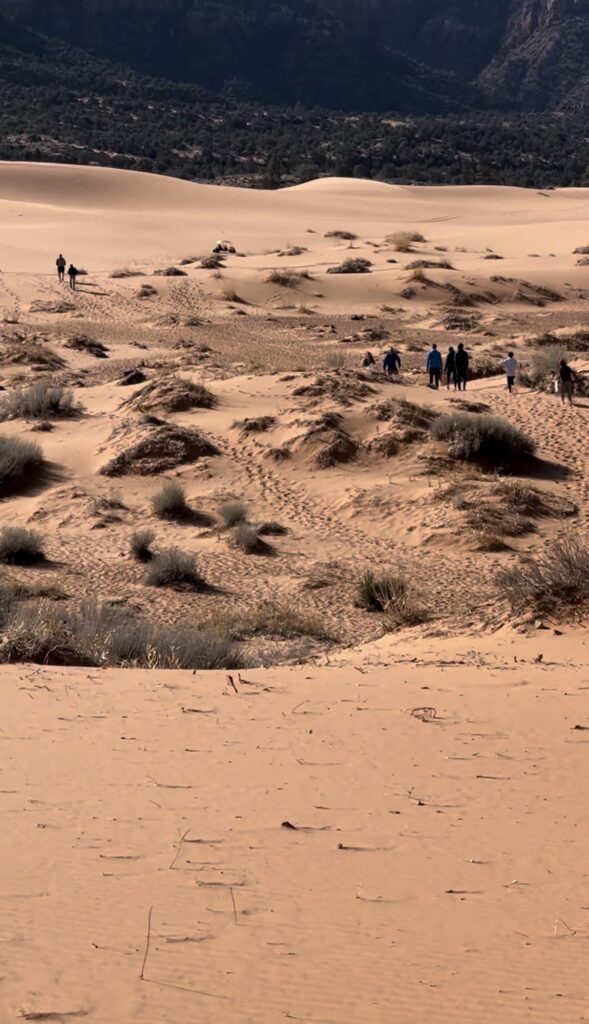
👀 Not Into Sand Hiking?
No problem!
There are places where you can enjoy the scenery without venturing deep into the dunes, including an observation area where you can take in the landscape and watch people playing on the sand.
Sometimes the best adventure is sitting back and watching everyone else work their way back up the giant hill they just sledded down. 😂
🛷 Should Your Dog Go Sand Sledding?
This is where we want to add a BIG safety disclaimer.
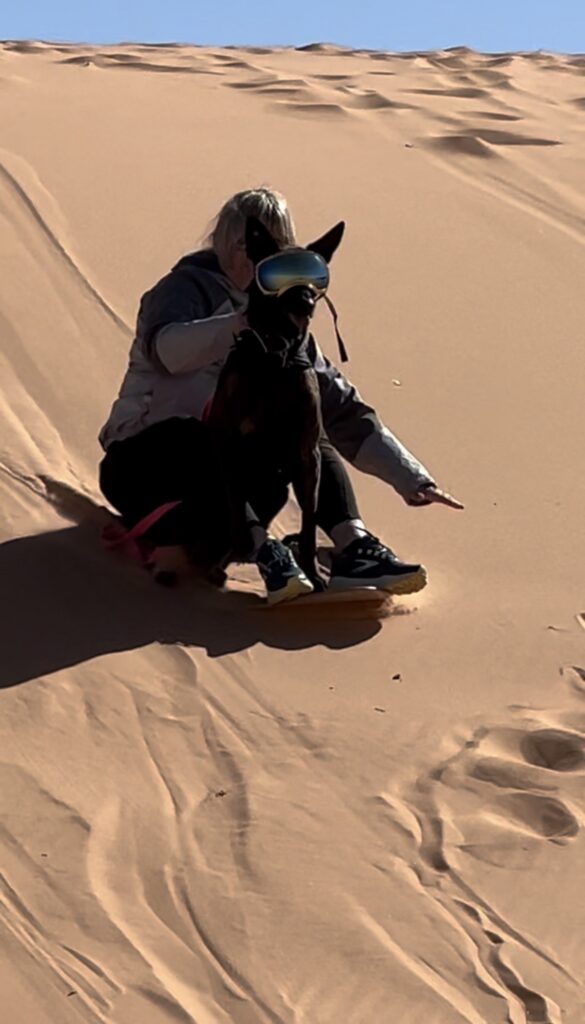
Sand sledding looks like a blast—and it is! The park rents sand sleds and sandboards for visitors. Current rental information from Utah State Parks lists them at $25 each, available at the Visitor Center on a first-come, first-served basis. Rentals must be returned 30 minutes before the Visitor Center closes.
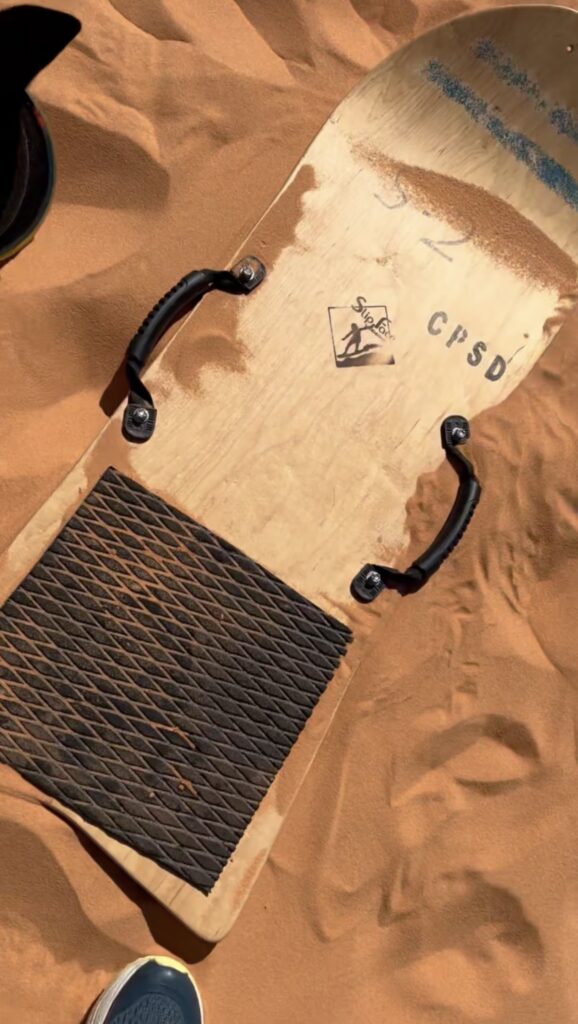
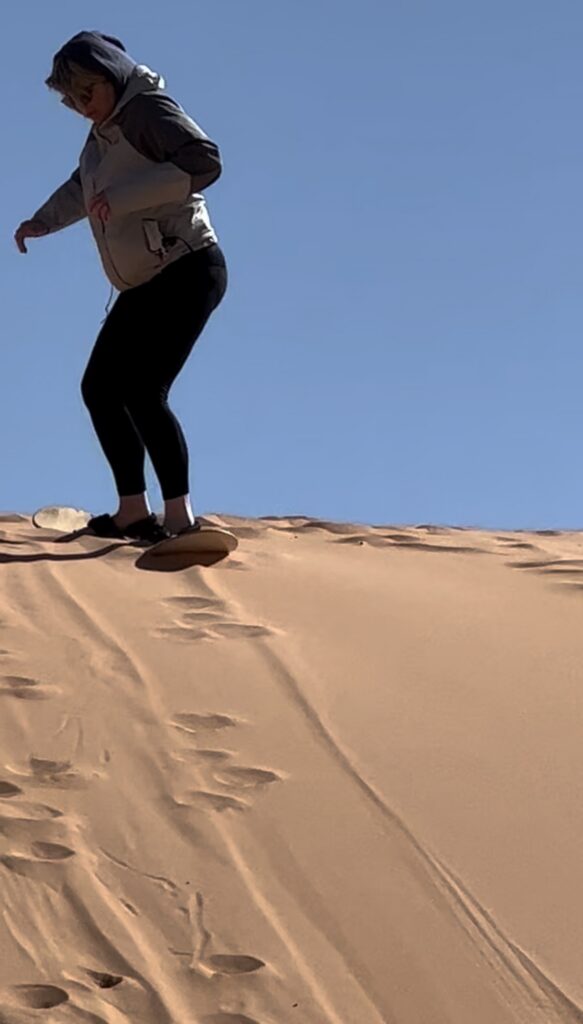
But should your dog ride with you?
We would not recommend this for most dogs.
We have a highly trained dog who is comfortable in a variety of situations, and we felt comfortable taking her on one very short, gentle hill. She was able to sit calmly between our legs and could get off the sled quickly if she became uncomfortable.
That was our personal decision based on knowing our dog.
That does not mean we think every dog should do it.
If you decide to consider sledding with your dog, you need to know your dog’s temperament, size, physical ability and comfort level—and understand that there is a real possibility of injury.
A dog trying to jump off, catching a leg in the sand, or shifting suddenly could turn a fun ride into an accident.
Our advice?
When in doubt, leave the dog off the sled.
Your pup can have an absolutely fantastic time exploring the dunes beside you without ever taking a ride.
And honestly, we’d much rather have a happy, healthy dog at the end of the day than a great sledding video for social media.
No adventure is worth risking your dog’s safety. ❤️🐾
🚙 One More VERY Important Safety Reminder
Coral Pink Sand Dunes is also a popular OHV destination.
That means you’ll have people riding vehicles through portions of the dunes. Utah State Parks specifically notes that vehicles use much of the dune area, while conservation areas for the Coral Pink Sand Dunes tiger beetle are marked and closed to vehicles.
This is another reason we believe keeping your dog leashed is so important.
A dog that suddenly sees a rabbit, another dog, or something interesting in the distance could easily run into the wrong place at the wrong time.
Leash on. Eyes open. Enjoy the dunes.
🦊 What About Wildlife?
Yes—there is wildlife here, and that’s something dog owners should know about.
The broader Coral Pink Sand Dunes and Moquith Mountain area supports animals including coyotes, foxes, mule deer, jackrabbits, rodents, bats and a variety of birds of prey. Golden and red-tailed hawks use the surrounding trees and rocky areas, and bald eagles may roost in the area during winter.
Utah State Parks also specifically reminds visitors not to feed wildlife and warns that snakes and scorpions can live under rocks.
So we’d add one more rule to your dog-adventure checklist:
Don’t let your dog investigate holes, rocks, wildlife or anything else that looks suspiciously interesting.
Because, of course, that’s exactly the stuff our dogs think deserves a closer inspection. 😂
🪲 And Then There’s the Tiny Resident You Probably Won’t Notice
One of the park’s most fascinating residents is the Coral Pink Sand Dunes tiger beetle, an insect found only in this area.
It’s an important part of the park’s ecosystem, and certain areas have been designated for conservation. Visitors using OHVs need to watch for the posted conservation-area signs and stay out of restricted areas.
It’s a good reminder that we’re not just playing in a giant sandbox.
We’re visiting a living ecosystem.
Leave the plants, wildlife and natural features where you find them, and pack out what you bring in.
🏕️ Make It a Day Trip—or Stay Overnight
We visited as a day trip, and that worked perfectly for us.
But if you’d rather slow things down, Coral Pink Sand Dunes also has a campground.
The current campground includes both traditional sites and newer sites with water and electric hookups. Pets are allowed as long as they’re kept leashed and aren’t left unattended.
That could make for a really fun Southern Utah camping adventure—especially if you’re building a trip around other nearby destinations.
And after sunset?
Look up. 🌌
This is the kind of desert landscape where settling in for an evening under the stars can be pretty special.
💰 What Does It Cost?
Current Utah State Parks information lists the day-use fee at:
$15 per vehicle
Utah seniors 65+ receive a reduced $10 vehicle fee. Federal passes are not accepted for the park’s day-use fee.
The park is currently listed as open during daylight hours, seven days a week.
Because park hours, fees, weather conditions and facilities can change, always check the official park website before heading out.
🧡 A Note About Tribal Lands & Sacred Places
This is something we think is especially important when traveling around Southern Utah.
The landscape around Coral Pink Sand Dunes isn’t simply beautiful desert—it is also part of a much larger cultural landscape with deep Indigenous history.
The surrounding region includes places connected to the Kaibab Paiute and other Indigenous peoples, and nearby areas contain archaeological and cultural resources. BLM information for the Moquith Mountain Wilderness Study Area notes prehistoric sites, while the National Park Service documents the deep cultural relationship the Kaibab Paiute have with this region.
Do not assume that because you can legally take your dog into the state park, you can take your dog everywhere in the surrounding area.
If you venture beyond Coral Pink Sand Dunes State Park onto nearby tribal lands, cultural sites, or other protected areas, check the rules for that specific location first. Some places have restrictions on pets, access, photography or where visitors may go.
For example, nearby Pipe Spring National Monument has very different pet rules: pets are restricted to certain areas and must remain on leash, and they are not permitted in historic buildings or on the Ridge Trail. The site also has deep cultural significance to the Kaibab Paiute people.
So please don’t cross a boundary and assume the same rules apply.
Respect the land. Respect tribal sovereignty. Respect sacred places. And when an area says dogs—or people—aren’t allowed, that’s where the adventure ends. ❤️
📸 Why We Think You Should Go
There are plenty of beautiful places in Southern Utah.
But Coral Pink Sand Dunes feels different.
It’s colorful. It’s unusual. It’s fun. You can hike, explore, take photographs, watch the OHVs, play in the sand, rent a sled or sandboard, camp—and, most importantly for us, bring your dog along for the adventure. 🐾
Our early-April visit gave us cool sand, chilly air, blue skies and a happy dog.
And that’s exactly what we want from a dog-friendly destination.
Not every adventure needs to involve a huge hike or a long list of attractions.
Sometimes you just need a leash, some water, a camera, a big pile of pink sand and a dog who is ready to investigate everything. 😂🐶🏜️
⭐ Our Traveling Dogs Life Takeaway
Coral Pink Sand Dunes State Park gets a big PAWS UP from us! 🐾🐾🐾🐾🐾
If you’re planning a dog-friendly Southern Utah road trip, we think this colorful little gem is absolutely worth adding to your itinerary.
Just remember:
Check the weather. Protect those paws. Bring plenty of water. Keep your dog leashed. Watch for OHVs and wildlife. Respect conservation areas and sacred/cultural places. And always check the current rules before you go.
Because the best adventures aren’t just about where you go.
They’re about making sure everyone—including the dog—gets home happy and healthy. ❤️🐾