Hot pavement is only part of the danger. Here’s what dog owners should know about paw burns, overheating, hydration and recognizing when the heat may be too much for their dog.

Summer often means one thing:
Vacation season. ☀️🚗
But when we’re traveling with our dogs, summer doesn’t automatically mean it’s the best time for an adventure.
In fact, many of our dog-friendly trips happen from fall through spring.
Heat is one of the reasons.
When we’re deciding whether to take our dogs somewhere, we’re thinking about more than whether the destination allows dogs. We’re thinking about the air temperature, the surfaces they’ll be walking on, how much shade will be available, how strenuous the activity will be—and whether our dogs can comfortably enjoy the experience.
Because sometimes the destination isn’t the problem.
Sometimes it’s the season.
And one of the easiest heat hazards to overlook is literally right under our dogs’ feet.
☀️ 77°F Outside Doesn’t Mean 77°F Under Their Paws
You check the weather.
It says 77°F.
That doesn’t sound terribly hot.
But the temperature on your weather app is air temperature. It doesn’t tell you how hot the sidewalk, asphalt, sand or artificial turf has become after sitting in direct sunlight.
Those surfaces can become substantially hotter than the surrounding air.
According to the UC Davis School of Veterinary Medicine, sidewalks, asphalt, sand and artificial turf can become dangerously hot during summer and can burn a pet’s paw pads.
The American Kennel Club’s veterinary guidance similarly warns that surfaces including asphalt and artificial grass can become hot enough to cause discomfort, blisters and burns.
In other words:
The weather app tells you the air temperature. Your dog isn’t walking on the air.
🌡️ One Example of How Different the Ground Can Be
Here’s an example that helps put the difference into perspective.
Published meteorological reporting has shown that when the outside air temperature is around 95–100°F, surface temperatures in direct sun may be approximately:
🌱 Natural grass in the sun: 105°F
⬜ Concrete: 125°F
⬛ Asphalt: 140°F
Those numbers are examples—not a temperature conversion chart.
Actual surface temperatures can vary considerably depending on direct sunlight, shade, surface material and color, moisture, wind, time of day and other environmental conditions.
The point isn’t that 95°F air will always produce exactly 140°F asphalt.
The point is much simpler:
The ground beneath your dog’s paws may be far hotter than the air around you.
That’s why we don’t decide whether a walking surface is safe based on the weather app alone.
🌱 Green Doesn’t Always Mean Cool
Grass is often one of the first alternatives we look for when pavement is hot.
But there’s an important distinction:
Natural grass and artificial turf aren’t the same thing.
Artificial grass can become extremely hot in direct sunlight.
And that’s something dog travelers may encounter more often than they realize.
Artificial turf is commonly used in places such as dog parks, designated dog potty areas, hotels, apartment complexes and other pet-relief areas.
It’s green.
It looks like grass.
That doesn’t mean it’s cool.
According to UC Davis School of Veterinary Medicine, artificial turf is one of the surfaces that can become dangerously hot during summer.
So before letting our dogs walk onto artificial turf that’s been sitting in the sun, we treat it just like pavement or any other potentially hot surface:
We check it first.
Your dog doesn’t care what color the ground is.
Their paws care how hot it is.
✋ The 7-Second Pavement Test
There’s a very simple test that can help you evaluate a surface before asking your dog to walk across it.
UC Davis School of Veterinary Medicine currently recommends placing the back of your hand against the pavement for seven seconds.
If you can’t comfortably keep your hand there for seven seconds, it’s too hot for your pet to walk on.
You may also see slightly different versions of this test. Current American Kennel Club veterinary guidance, for example, recommends a similar hand test for 10 seconds.
We don’t think the important takeaway is whether you’re counting:
Five…six…seven…
or:
Eight…nine…ten…
while your dog wonders what on earth you’re doing. 😂
The important thing is to physically check the surface instead of assuming it’s safe.
And there’s another important limitation:
The hand test evaluates the surface. It doesn’t tell you whether the overall weather conditions are safe for your individual dog.
A shaded sidewalk might feel comfortable while the surrounding heat, humidity or activity level could still put a dog at risk of overheating.
So checking the ground is important.
Checking your dog is even more important.
🐾 Paw Pads Aren’t Shoes
Dogs’ paw pads are tough.
But they aren’t indestructible.
Hot sidewalks, asphalt, concrete, sand and artificial turf can cause painful burns and injuries.
And don’t forget about rock itself.
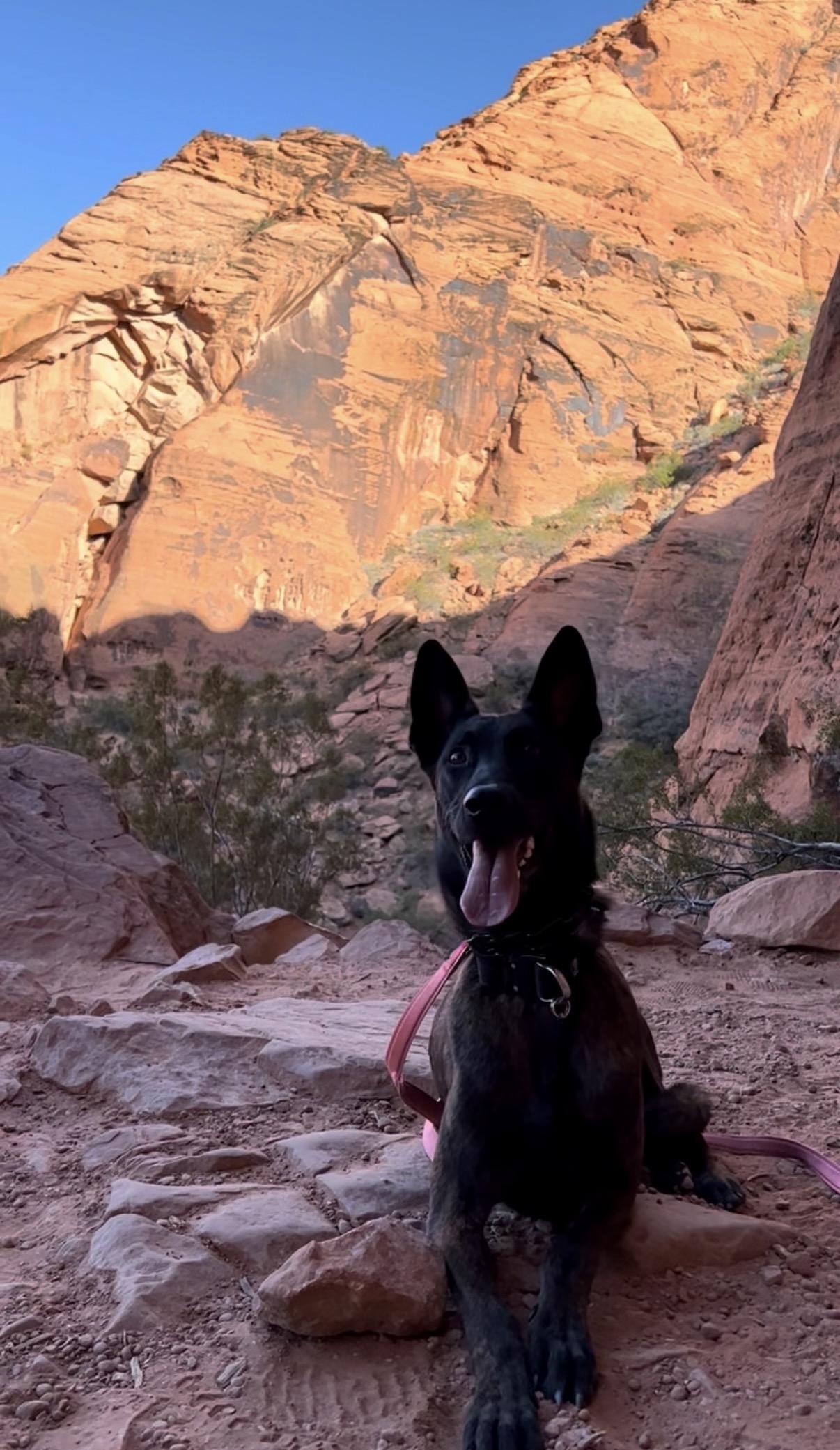
In desert and red-rock areas, exposed sandstone and other rock surfaces can sit in direct sun for hours and become extremely hot. We’ve learned not to assume a trail surface is safe simply because it isn’t asphalt or concrete.
This matters especially where dogs may need to climb or scramble over rock. Once a dog gets onto an uncomfortable surface, getting back down may not be as simple as turning around.
If we’re unsure about the surface, we check it before asking our dogs to step onto it.
That’s especially easy for us humans to underestimate because we’re usually wearing shoes.
Our feet may feel perfectly comfortable while our dogs are walking directly on a surface we wouldn’t dream of standing on barefoot.
If we’re unsure, we check.
And if the surface is too hot, our solution isn’t necessarily to figure out how to make our dog walk across it anyway.
Sometimes we can:
- Choose a shaded or grassy route.
- Visit earlier in the morning or later in the day.
- Use appropriate paw protection when necessary.
- Shorten the outing.
- Change the activity.
- Come back another day.
Sometimes the safest solution is simply:
Don’t walk the dog across that surface.
🌡️ It’s Not Just About Their Paws
This may be the most important point in this entire article.
Hot pavement is only one part of heat safety.
A dog’s paws can be perfectly fine while the dog is still becoming dangerously overheated.
Dogs don’t regulate body temperature the same way people do. According to UC Davis School of Veterinary Medicine, dogs primarily cool themselves through panting, with only limited sweating through their paw pads.
That means we need to pay attention to the whole dog, not just their feet.
Temperature, humidity, direct sunlight, activity level, access to shade and water, physical condition and the individual dog can all affect how well that dog handles the heat.
A comfortable walking surface doesn’t automatically mean:
“We’re good to go.”
🐶 Some Dogs Need Extra Caution in the Heat
There isn’t one magic outdoor temperature that’s safe for every dog.
Some dogs are more vulnerable to heat-related illness than others.
Veterinary guidance identifies factors including short-nosed or flat-faced anatomy, excess body weight, respiratory disease and other health conditions as increasing heat risk. Age, fitness, coat, acclimatization and the intensity of the activity can matter too.
And this is another reason we come back to something we say often:
Know the dog in front of you.
Not your neighbor’s dog.
Not another dog of the same breed.
Not even necessarily the dog you had five years ago.
Your dog today.
A dog who comfortably handled a particular walk when they were younger may need something different now.
And a dog who lives in a cooler climate may respond differently to sudden heat than one who has gradually acclimated to warmer conditions.
When in doubt—especially if your dog has a health condition or you have questions about their individual heat tolerance—talk with your veterinarian.
💧 Don’t Wait Until Your Dog Looks Miserable
Fresh water, shade and rest shouldn’t be emergency measures.
They’re part of planning the adventure.
We bring plenty of fresh water and offer it regularly. We look for reliable shade. We build in breaks.
And we keep watching the dog.
That’s particularly important when dogs are excited and having fun.
A dog chasing a ball, hiking a trail, playing at the beach or exploring somewhere new may not make the same decision we would make for them:
“You know what? I think I’ve exercised enough. I’ll go lie quietly in the shade now.” 😂
Sometimes we need to be the one who ends the game, takes the break or calls it a day.
🚨 Know the Warning Signs of Heat-Related Illness
Heatstroke can become life-threatening.
According to current UC Davis School of Veterinary Medicine guidance, warning signs of heat-related illness can include:
- Excessive or uncontrolled panting
- Excessive drooling
- Lethargy or weakness
- Vomiting or diarrhea
- Bright or dark-red gums
- Rapid or difficult breathing
- Wobbliness or confusion
- Collapse
- Seizures
Don’t wait for every symptom on the list to appear.
If your dog is showing concerning signs after heat exposure or exercise, stop the activity and seek veterinary guidance immediately.
Heat-related illness can progress quickly.
🆘 If You Think Your Dog Is Overheating
Heatstroke is a medical emergency.
If you suspect your dog is suffering from heat-related illness, contact your veterinarian or an emergency veterinary hospital immediately.
Move your dog out of the heat and into a cool or shaded area.
UC Davis veterinary guidance recommends beginning cooling with cool or room-temperature water rather than ice-cold water, and a veterinarian may instruct you to begin cooling your dog while you’re on the way for emergency treatment.
This isn’t the time to finish the hike, see whether your dog “gets better in a few minutes,” or search through twenty different opinions online.
Call a veterinarian.
When it comes to possible heatstroke, professional veterinary care matters.
🚗 Never Leave a Dog in a Parked Car
No summer heat-safety discussion would be complete without this one.
Never leave your dog unattended in a parked vehicle in warm conditions.
Vehicle interiors can heat rapidly and reach dangerous temperatures even when the outdoor temperature doesn’t seem extreme.
Cracking the windows doesn’t make a hot vehicle safe.
Neither does saying:
“I’ll only be gone a few minutes.”
If the dog can’t safely come with us where we’re going, we make another plan.
🌅 Sometimes Changing the Time Changes the Adventure
One of the easiest ways to make a warm-weather adventure safer may be changing when you do it.
Early mornings and evenings can offer cooler air and cooler surfaces than the middle of the day.
Shade can change throughout the day too.
A trail that’s exposed and miserable at 2:00 in the afternoon may be an entirely different experience early in the morning.
And sometimes we go one step further.
We change the season.
Many of our adventures happen between fall and spring for exactly this reason.
We’re still visiting beautiful places.
We’re still traveling with our dogs.
We’re still having adventures.
We’re simply choosing conditions that may allow our dogs to enjoy those adventures more comfortably.
❤️🐾 The Adventure Doesn’t Have to Happen Today
This is one of those lessons that applies to so much of traveling with dogs.
We can plan.
We can pack.
We can research.
We can drive all the way there.
And conditions can still tell us:
Not today.
Maybe the pavement is hotter than expected.
Maybe there isn’t enough shade.
Maybe the temperature climbed faster than forecast.
Maybe our dog is tiring sooner than usual.
Maybe we’re standing at the beginning of an adventure we’ve been looking forward to and realizing that continuing isn’t the best choice for the dog standing beside us.
Changing the plan isn’t ruining the adventure.
It’s taking care of the dog we’re having the adventure for in the first place.
Sometimes responsible dog travel means changing the time.
Sometimes it means changing the route.
Sometimes it means shortening the outing.
Sometimes it means leaving the dog somewhere cool and comfortable while we go without them.
And sometimes it isn’t the destination that needs to change.
It’s the season.
Because dog-friendly doesn’t always mean right for every dog, every day or every situation.
The goal isn’t simply to take our dogs everywhere.
It’s to take them on adventures they can safely enjoy—and a lifetime of good days together. ❤️🐾
📚 Sources & Further Reading
We believe safety information should come from credible sources, especially when we’re discussing topics like burns, overheating and heatstroke.
For this article, we relied primarily on current veterinary and public-land guidance from:
UC Davis School of Veterinary Medicine — Summer Pet Hazards
Current veterinary guidance covering heatstroke, overheating, burned paw pads, artificial turf, the seven-second pavement test and other summer hazards.
UC Davis School of Veterinary Medicine — Heat-Related Illness in Dogs
Additional information about risk factors, warning signs, prevention and what to do if heat-related illness is suspected.
American Kennel Club — How Hot Is Too Hot for a Dog’s Paws?
Updated March 2026, with veterinary guidance about hot pavement, artificial grass, paw burns, heat-related illness and checking surface temperatures.
U.S. Bureau of Land Management — Moab Visitor Guidance
Public-land safety guidance addressing desert heat, hot trail surfaces and the risk of burned paw pads when traveling with dogs in red-rock country.
For the example illustrating how dramatically different surfaces can heat in direct sunlight, we also referenced published meteorological reporting showing approximate surface temperatures under specific hot-weather conditions.
Remember that surface temperatures vary with environmental conditions, and examples should never replace checking the actual conditions where you and your dog are.
🐾 A Quick Paws-Up
We’re dog owners sharing what we’ve learned through our own travels, experiences and research. We are not veterinarians, and this article is not a substitute for veterinary advice.
Every dog is different. Age, breed, health, fitness, body condition, coat, acclimatization, medications and other factors may affect how a dog responds to heat.
If you have questions about your dog’s individual heat tolerance or health, talk with your veterinarian.
If you believe your dog may be experiencing heat-related illness or heatstroke, contact a veterinarian or emergency veterinary hospital immediately.